
Businesses Are Desperate for AI. They Just Don't Know How to Use It

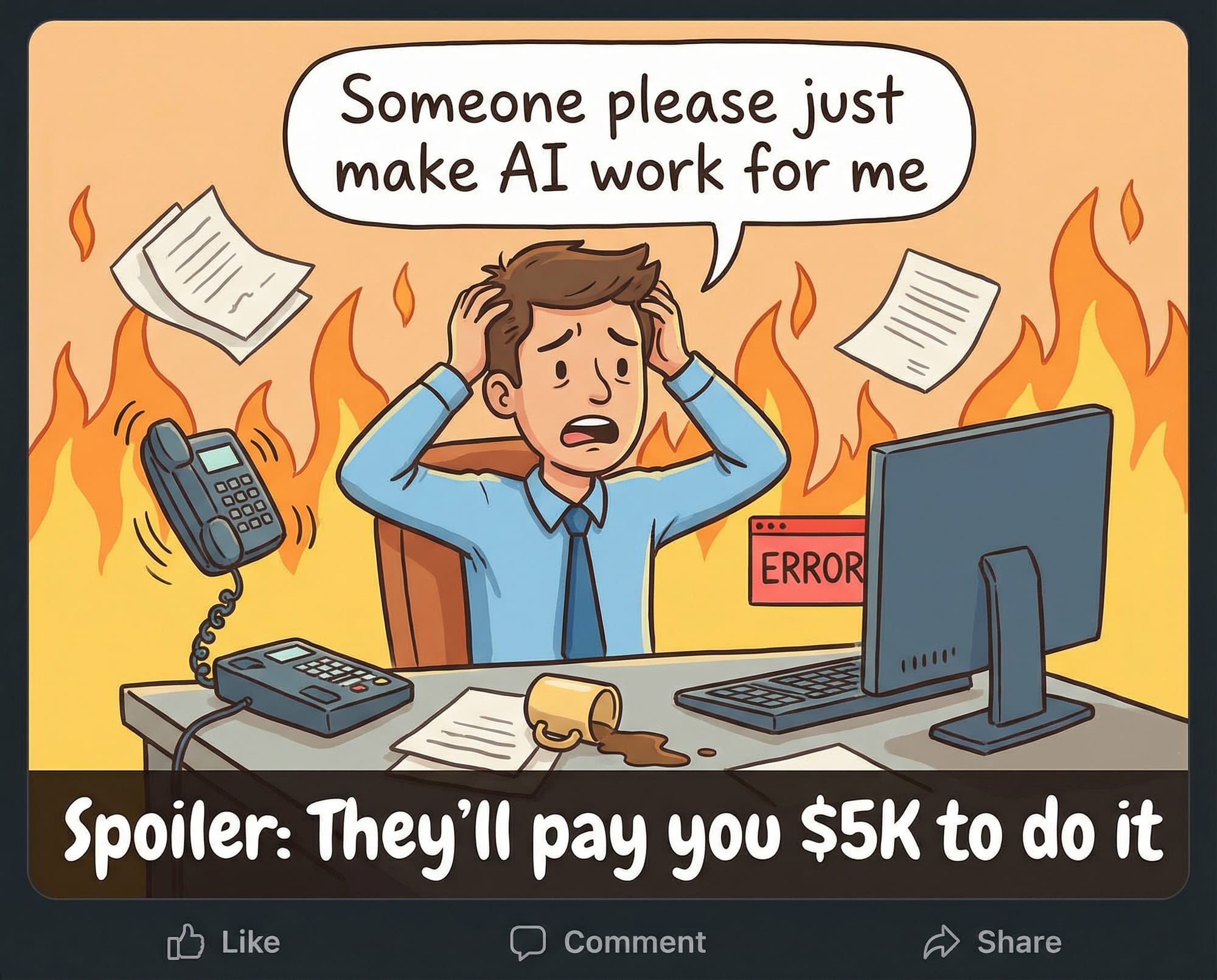
And why being the 'middleman' who connects them is more profitable than building AI tools yourself
Right now, while you're reading this, there's a hair salon owner somewhere losing $500 this week because she's cutting hair when the phone rings.
There's a plumber who just sent another emergency call to voicemail because his hands are literally covered in shit.
And there's a law firm paying some poor soul $50K a year to answer phones and take notes - work that could be done by AI for a fraction of the cost.
These aren't hypothetical problems. This is happening right now. Today. In thousands of businesses.
And here's the kicker: the solutions already exist.
AI receptionists that never miss a call.
AI booking systems that schedule appointments while you sleep.
AI intake assistants that qualify leads 24/7 without complaining about overtime.
The tools are built. They work. They're sitting there, ready to be used.
So why aren't these businesses using them?
Because they have no fucking (sorry about bad language) clue how to actually implement them.
They've heard about AI. They've seen the headlines. Maybe they even tried ChatGPT once and thought, "Cool, but now what?"
But between running payroll, dealing with angry customers, and trying to keep the lights on, they don't have time to:
- Research which AI tools actually work
- Figure out how to integrate them into their business
- Test different platforms
- Troubleshoot when something breaks
- Actually make it all work together
So they stay stuck.
Bleeding money. Missing opportunities. Watching their competitors figure it out first.
And that gap, between businesses desperate for AI solutions and the tools that could save them, is where you come in.
Not as the person who builds AI tools (thank god, because who has time for that?).
Not as some "AI guru" posting motivational content on LinkedIn.
Not as a coder spending years learning Python.
You come in as the connector.
The person who says, "Hey, I know exactly which tool solves your problem and increase your ROI by 50%, and I can have it running in your business by next week."
That's it. That's the whole game.
And businesses will pay you $3K to $10K to do it.
If you've been trying to "break into" the AI space, you've probably been told one of these things:
"Learn to code so you can build AI tools"
"Become an AI expert and build a personal brand"
"Start posting AI content every day to attract clients"
"Build your own SaaS product"
And maybe you tried.
Maybe you started a Python course, got to "Hello World," and thought, "What the fuck does this have to do with making money?"
Maybe you forced yourself to post on LinkedIn about AI, got 12 likes from bots in Bangladesh, and felt like a complete idiot.
Maybe you spent three months "researching" (aka watching YouTube videos at 2x speed) and never actually launched anything because you didn't know where to start.
Here's the problem with all that advice:
It assumes you need to be the creator.
It assumes you need to build the tools, invent the solutions, or become the next Elon Musk tweeting about neural networks at 3 AM.
And for most people, that's not just hard. It's the wrong game entirely.
Because while you're spending months learning to code or years building an audience of people who will never buy anything, businesses are right now, today, searching for someone who can just help them implement what already exists.
They don't need you to invent AI.
They need you to install it.
They don't care if you built the tool.
They care if you can make it work for their specific business without them having to watch a 47-part YouTube tutorial series.
Think about it like this:
When a restaurant needs a new oven, they go to an oven shop, buy one, and pay for installation. Nobody expects the installer to have invented ovens or to explain thermodynamics.
When a business needs AI, they don't need you to build ChatGPT. They just need you to know which tool solves their problem and how to get it running.
The real problem isn't that you're not technical enough.
The real problem is you've been trying to be the builder when you should be the connector.
And that's a much simpler, faster, and more profitable game to play.
Let's be honest about why most attempts to build a side income or escape the 9-5 don't work.
Attempt #1: Freelancing or agency work
You tried offering services. Maybe marketing, design, consulting, whatever you're good at. But getting clients was a nightmare. Cold outreach got ignored. Upwork was a race to the bottom. Referrals dried up.
Not because you weren't good at what you do, but because client acquisition is a full-time job on its own. And you're already working full-time.
Got full time client? Good you just switched your day job to another day job but now without "employee benefits". Scaling own time is impossible. We only have 24h/day, nothing can change that.
Attempt #2: Building a personal brand
Someone told you to "just post content" and clients will come. So you tried. You posted on LinkedIn. Maybe TikTok. You got some likes, maybe a few comments, but zero clients.
Not because your content was bad, but because building an audience that actually buys takes months or years. And most followers just want free advice so they can go try it themselves.
Attempt #3: Launching a product or course
You spent weeks (or months) creating something. An ebook. A course. A template pack. You launched it. Crickets. Maybe a few sales from friends who felt bad for you.
Not because your product sucked, but because you had no audience, no traffic, and no idea how to actually sell it. Turns out "build it and they will come" is bullshit.
Attempt #4: Trying different side hustles
Dropshipping. Print on demand. Affiliate marketing. You tried a bunch of things. Some made a few bucks. None stuck. You got overwhelmed by all the moving parts and gave up (I have been there and got almost burnt out).
Not because you lacked motivation, but because most side hustles require either massive upfront investment, months of grinding, or both. And nobody showed you a model that actually scales without burning you out.
Here's what all of those approaches have in common:
They all depend on YOU constantly finding new clients or customers.
But what if there was a model where businesses are already searching for what you offer?
Where the demand exists, the tools exist, and you just need to connect the two?
That's exactly how the connector model works.
Think about how AirBnB works.
AirBnB hosts don't build houses.
They don't create demand for travel.
They don't need to be real estate experts.
They just connect people who need a place to stay with spaces that already exist.
And they profit from being the middleman.
AI Flipping works exactly the same way.
You don't build AI tools. (They already exist.)
You don't need to find demand. (Businesses are already searching.)
You don't need to be a tech expert. (The tools are plug and play.)
You just connect businesses that need AI solutions with the tools that solve their problems.
And you profit from being the connector.
Here's what that looks like in practice:
Step 1: Pick a proven AI system
AI receptionists (Thoughtly, ManyChat), booking automations (GHL), lead generation systems (Instantly, AISDR), client onboarding flows (Intercom FIN AI). These are already built, tested, and ready to install.
Step 2: Find a business that needs it
Hair salons, plumbers, law firms, real estate agents, gyms. Thousands of local businesses are losing money because they don't have these systems.
Step 3: Install it for them
You don't code it. You don't build it. You just plug it into their business using tools like GoHighLevel, Make.com, or n8n.
Step 4: Charge $3K to $10K for the setup
Plus optional monthly retainers for maintenance and updates.
Step 5: Repeat across different niches
The same AI receptionist system that works for a salon works for a plumber, a dentist, a lawyer. You just customize it slightly and sell it again.
That's it.
No coding. No content creation. No chasing clients on social media.
Just connecting problems with solutions and getting paid well to do it.
This model works because of three simple truths:
Truth #1: Businesses will always pay more than consumers
A $27 course? Hard to sell. You'll spend three weeks writing sales copy, arguing with people in the comments about whether it's "worth it," and dealing with refund requests from someone who "didn't have time to watch the videos."
A $5,000 AI system that saves a business $50K/year? Easy.
Businesses don't buy based on price. They buy based on ROI. If your AI receptionist saves them one missed client per week, it pays for itself in a month. And they don't ask for refunds because "the AI didn't vibe with their energy."
Truth #2: The tools already exist and work
You're not selling vaporware or unproven ideas. You're not promising some revolutionary breakthrough that'll be ready "in 6 months" (aka never).
These AI systems are already running in thousands of businesses. Thoughtly is answering calls. Instantly is booking meetings. GHL is managing entire client pipelines.
You're just installing what's proven. Like being the guy who sets up someone's WiFi router. The router works. You just plug it in and make sure they don't fuck it up.
Truth #3: Most businesses can't (or won't) do this themselves
They're too busy running their business. They don't have time to research tools, test integrations, watch tutorials, or troubleshoot why the API key isn't working (spoiler: they copied it wrong).
They'll gladly pay someone to handle it for them. Just like they pay someone to fix their plumbing even though YouTube could technically teach them how.
And here's the part that makes this truly scalable:
You can sell the same system to 100 different businesses.
An AI receptionist for a hair salon is 90% the same as an AI receptionist for a plumber. You just change the greeting from "Thanks for calling Salon Sparkle" to "Thanks for calling Joe's Plumbing, how can we help with your shit situation today?"
You build it once. Customize it slightly. Sell it again. And again. And again.
That's how people go from $0 to $10K/month in 30 to 60 days.
Not by inventing something new every time.
But by duplicating what works across different niches.
Like a smart person.
Let's say you decide to focus on AI receptionists for local service businesses.
Week 1: You install the system for a hair salon. They pay you $5,000 upfront + $500/month to manage it.
Week 2: You take that same system, customize it for a plumbing company. Another $5,000 + $500/month.
Week 3: A law firm sees your work and wants an AI intake assistant. $7,500 + $1,000/month.
Week 4: You duplicate the salon system for a different salon in another city. $5,000 + $500/month.
Month 1 total:
$22,500 in setup fees
$2,500/month in recurring revenue
Month 2:
You add 3 more clients. Now you're at $2,500 + $1,500 = $4,000/month recurring.
Month 3:
You add 3 more. Now you're at $5,500/month recurring.
By month 6, you have 15 to 20 clients paying you monthly retainers.
That's $8K to $12K/month in predictable income.
And you're not trading time for money anymore.
The AI systems run 24/7. You just monitor them, make small updates, and collect payments.
That's the power of the connector model.
"But I'm not technical."
Good. You don't need to be.
Seriously, being "technical" is overrated. Half the "tech gurus" online can barely set up their own email without calling support.
Here's what you actually need:
✅ Ability to follow step by step instructions (like IKEA furniture, but less frustrating)
✅ Willingness to learn simple tools (like GoHighLevel, which is easier than Excel)
✅ Basic understanding of how businesses operate (you know, they need customers and money)
✅ Ability to communicate value to business owners (without sounding like a robot)
That's it.
You don't need to:
❌ Write code
❌ Understand machine learning
❌ Build AI models from scratch
❌ Be a "tech genius" who uses Linux and drinks only black coffee
The AI tools are already built. The templates are ready. The systems are plug and play.
Your job is just to connect the dots.
Think of it like this:
You don't need to be a mechanic to drive a car.
You don't need to be a chef to follow a recipe.
You don't need to be a programmer to install AI systems.
You just need to know which tool solves which problem and how to install it.
And that's exactly what we teach you in AI Flipping method training.
Without the condescending tech bro attitude.
So how do you actually learn this model?
How do you know which AI systems to use?
How do you find businesses that need them?
How do you install them without getting overwhelmed?
How do you price and sell them confidently?
That's where AI Flipping comes in.
It's the complete system that shows you exactly how to become the connector.
Inside, you get:
✅ 5 done-for-you AI systems ready to install and sell
✅ 1-click templates so you're not building from scratch
✅ Cold email sequences that book high-ticket demos
✅ Sales scripts that close deals without being pushy
✅ Niche selection guides so you know which businesses to target
✅ Lead scraping tools to find thousands of prospects
✅ Outreach templates for Upwork, LinkedIn, and X
Everything you need to go from "I don't know where to start" to landing your first client.
Not theory. Not fluff.
Just the exact systems and templates that work.
Want to see how it works?
Click here to learn more about AI Flipping and see if it's right for you.
Here's what changes when you stop trying to build AI tools and start connecting them:
Week 1:
You install your first AI system. You see how simple it actually is. The overwhelm disappears.
Week 2:
You reach out to 50 local businesses using the cold email templates. 5 respond. 2 book calls.
Week 3:
You close your first client. $3,500 setup + $500/month retainer. You feel the shift. This is real.
Week 4:
You duplicate that system for a different niche. Another $3,500. You realize: this actually scales.
Month 2:
You have 5 clients. $2,500/month recurring. You're not trading time for money anymore.
Month 3:
You add 3 more. $4,000/month recurring. You start thinking about quitting your job.
Month 6:
You have 15 clients. $8K to $12K/month. You're working 20 hours/week. The systems run themselves.
You're not chasing clients.
You're not posting content.
You're not showing your face.
You're not burning out.
You're just connecting businesses with solutions and profiting from being the middleman.
That's the freedom the connector model creates.
Look, I'm not going to beg you to click a button.
You've read this far, so you're either:
A) Actually interested and ready to see how this works
B) Procrastinating at work (no judgment, we've all been there)
C) Waiting for me to throw in a free Lamborghini or something
Spoiler: There's no Lamborghini.
Just a straightforward system that shows you how to connect businesses with AI tools and get paid for it.
If that sounds less painful than another year of "I'll figure it out eventually," click below.
Learn More About AI Flipping →
Or don't. I'm not your dad.